Original article by the WAFU B2B team for hotel operators, property owners, and PropTech decision-makers. For compatibility questions in hotel projects, see also our B2B invisible lock compatibility guide.
Abstract
Traditional hotel lock systems can create avoidable work around credentials, handover and maintenance. WAFU SMART-LOCK+ is presented here as a project option for concealed hotel access management, mobile access and PMS-related workflows. Communication architecture, security evidence, battery life, integration scope and commercial return depend on the selected model, configuration, site and contract. This article therefore uses a project-specific evaluation framework rather than universal performance claims or a named customer case.
Keywords: hotel access control, hotel invisible lock, mobile access, dynamic access rights, hotel lock ROI framework, cardless check-in, PMS integration
01 Network scope
Confirm topology, gateway coverage, offline behavior and site-specific radio conditions.
02 Security evidence
Request the applicable security architecture, test documents and version scope.
03 Battery validation
Confirm battery type, usage assumptions, test conditions and low-power warnings.
04 PMS Integration
Deep API integration — access rights automatically tied to booking status.
05 ROI model
Use the hotel's own quantity, labor, card, energy and integration inputs.
Introduction: Systemic Limitations of Traditional Hotel Locks
The hotel industry currently faces four major structural pain points regarding access management:
- Outdated Security Protocols: Mechanical lock cylinders are vulnerable to technical picking, and magnetic cards are easily cloned; these systems fail to meet modern digital security standards, posing risks to both property and personal safety.
- Operational Inefficiencies: The physical processes of distributing, collecting, and replacing lost keycards consume significant front-desk manpower and time, leading to high operating costs and frequent guest complaints.
- Fragmented Guest Experience: Standalone physical access systems cannot form a closed-loop data integration with the hotel's PMS (Property Management System), CRM, and online booking channels, creating a disconnect between the physical and digital guest experience.
- Rigid and Opaque Access Management: Systems lack the ability to manage access dynamically and in real-time based on time, location, and identity, and they lack granular audit and traceability capabilities regarding staff and visitor activity.
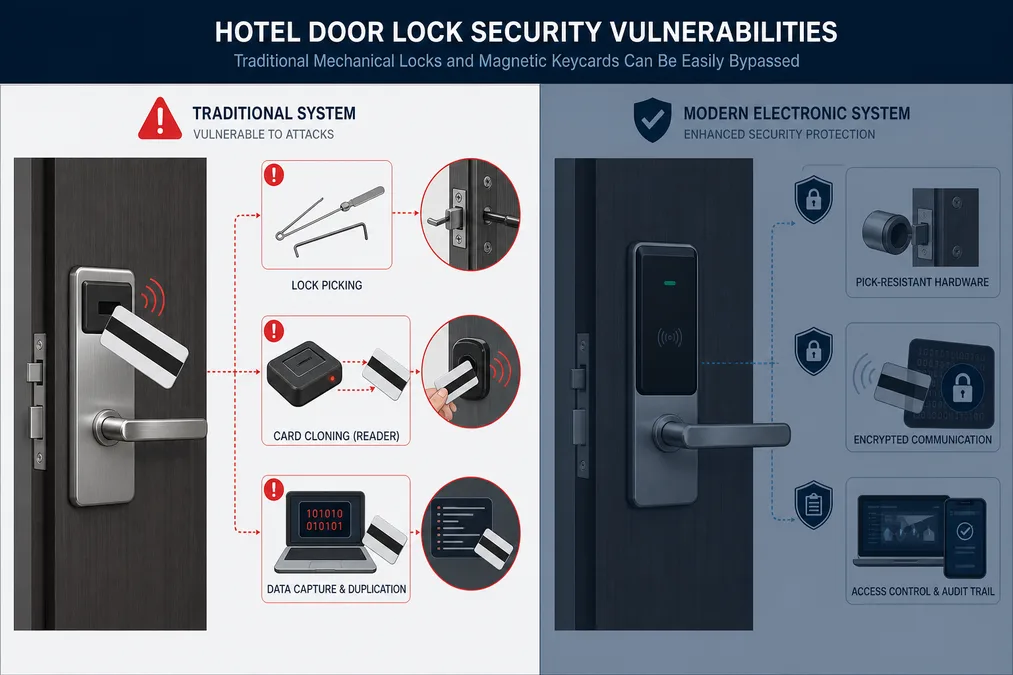
Incremental optimizations addressing these pain points are yielding diminishing returns; systemic transformation requires fundamental innovation at the underlying technology level.
Technical Architecture: The Principles Behind WAFU SMART-LOCK+
WAFU SMART-LOCK+ is not merely a piece of smart lock hardware; it is a software-defined smart access control system. Its core technical framework comprises the following modules:
- Network and communication scope: Confirm the selected radio architecture, gateway layout, offline behavior and interference conditions through the project specification and site validation. No coverage or stability guarantee should be inferred without configuration-specific evidence.
- Security architecture and evidence: Request the applicable encryption, key-management, firmware-update and audit documentation for the exact model and hardware/firmware version. Do not describe a product as holding a named security certification without a certificate and defined scope.
- Emergency and failure path: Define local operation, emergency egress, backup power and low-battery procedures with the hotel, installer and applicable local code. Verify each path on the supplied configuration.
- Authentication and Execution Units:
- Multimodal Authentication: Supports the official hotel app (via Bluetooth/NFC), dynamic passwords (one-time or time-limited), and encrypted smart cards/wristbands, with scalability for integrated fingerprint recognition.
- Servo-less Motor Drive: Employs a patented low-power, high-torque motor design to ensure rapid, reliable unlocking while providing the hardware foundation for core energy-saving algorithms.
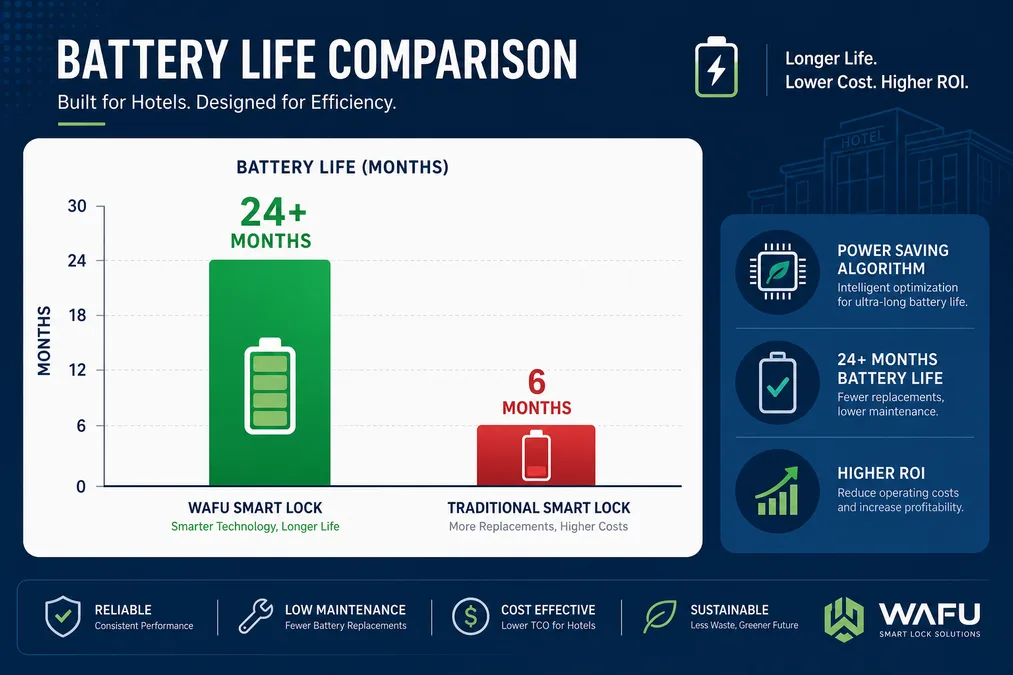
- Power and battery management: Review battery chemistry, access frequency, radio duty cycle, temperature, warning thresholds and replacement procedures. Battery life must be reported only with the applicable model, configuration and test conditions.
- Cloud Management and PMS Integration Layer: Integrates deeply with mainstream hotel PMS platforms (such as Oracle Opera, Protel, RMS, etc.) via standardized APIs and Webhooks, enabling automated access rights management—specifically, "authorization upon booking" and "deactivation upon checkout." All data transmission and storage strictly adhere to international data privacy compliance standards such as GDPR, supporting data masking, partitioned storage, and access control to ensure the highest level of guest privacy protection.
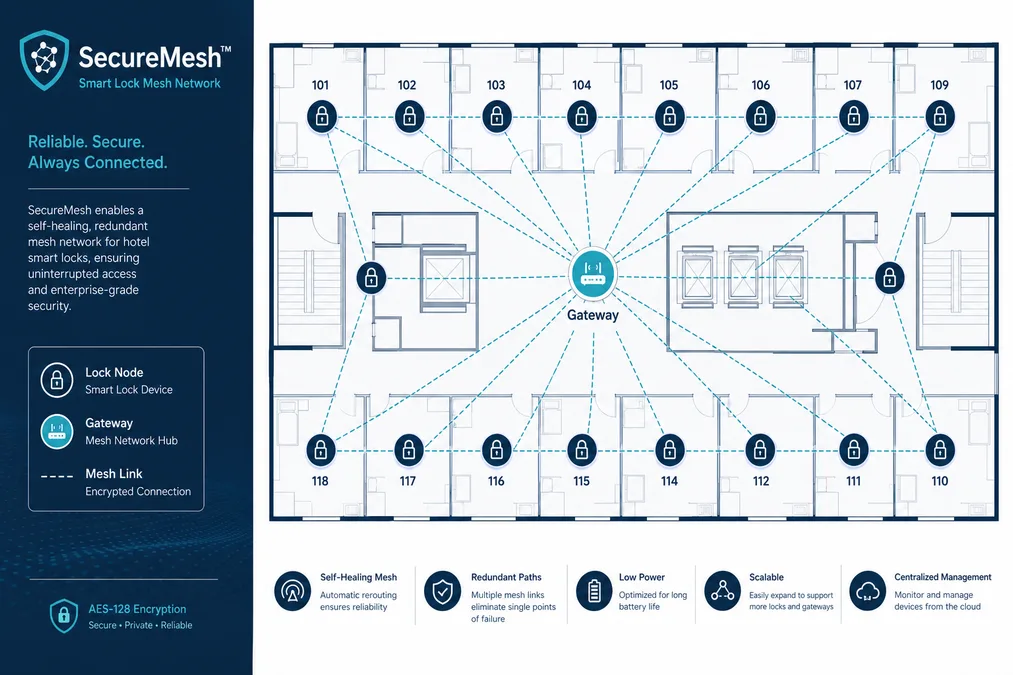
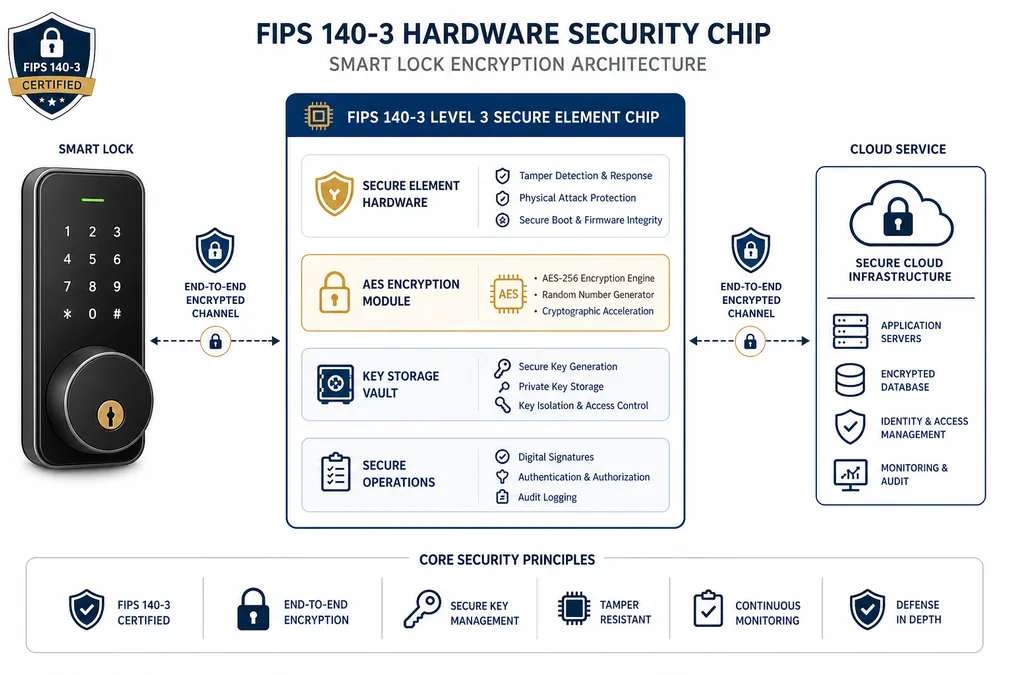
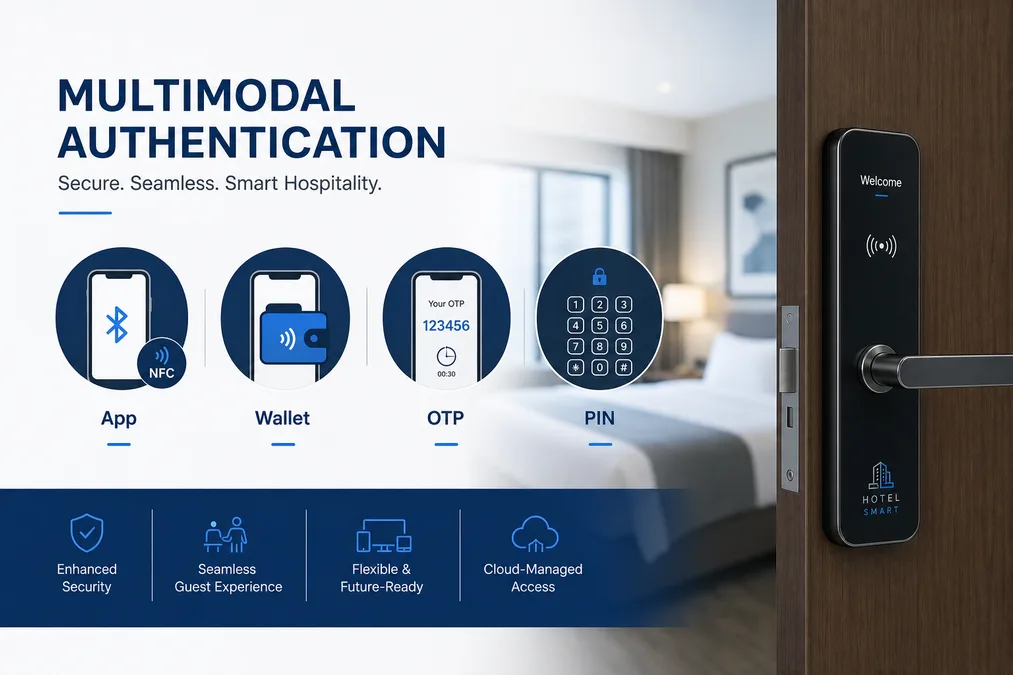
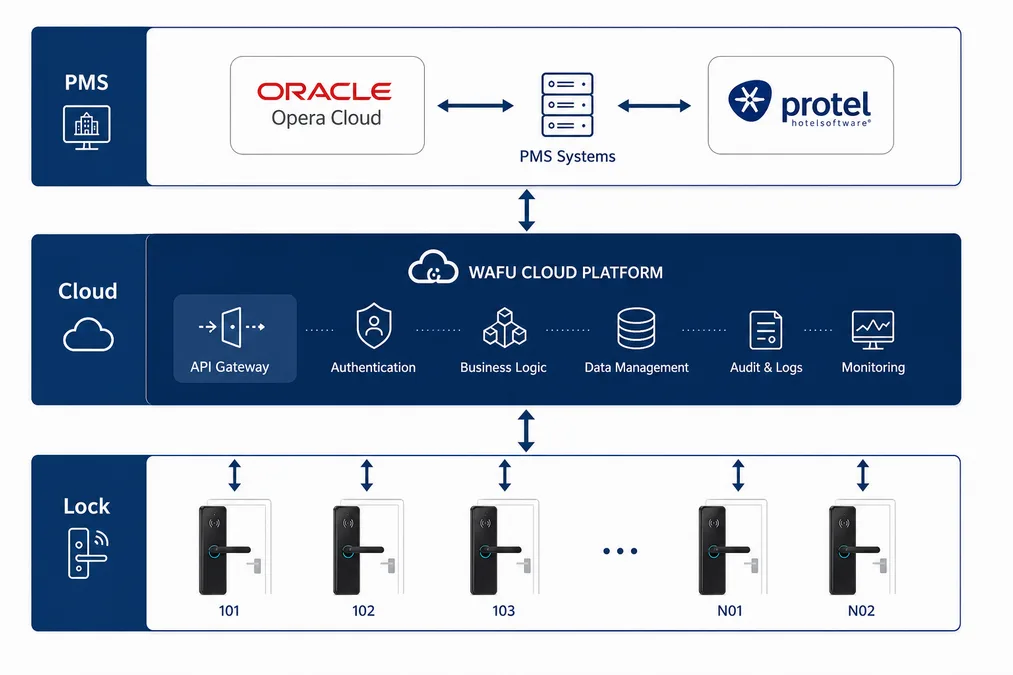
Its operational logic follows an end-to-end closed-loop process: "Credential Verification → Local/Cloud Security Authentication → Actuator Operation → Real-time Status Data Feedback to Cloud Platform."
Core Value: Strategic Upgrading of Hotel Operations
1. Redefining the Foundation of Security
- Minimizing the Physical Attack Surface: Eliminates exposed mechanical lock cylinders, fundamentally removing entry points for lock-picking or forced physical entry.
- Dynamic, Programmable Access Policies: Guest room access rights synchronize in real-time with PMS reservation statuses; staff access can be precisely configured based on individual identity, specific time windows (e.g., 08:00–18:00), and designated functional areas (linen rooms, storage).
- Full Lifecycle Audit Trail: All lock events (timestamp, ID, verification method, outcome) are encrypted and stored in the cloud, supporting real-time queries and data export to meet internal audit and compliance investigation requirements. All data transmission and storage strictly adhere to international data privacy compliance standards such as GDPR, supporting data masking, partitioned storage, and access control to ensure the highest level of guest privacy protection.
2. Exponential Optimization of Operational Efficiency
- Front Desk Process Re-engineering & "Zero-Wait Check-in": Enables a fully contactless check-in experience via Mobile Key. After booking online, guests can unlock their rooms using their smartphones at the scheduled time, reducing front-desk check-in time to near zero; this significantly alleviates operational pressure during peak periods and improves room turnover rates.
- Automated Scenario Integration: The act of unlocking the door serves as a trigger to activate the room's RCU (Room Control Unit) and initiate preset "welcome modes" (lighting, climate control, curtains). It also integrates with energy management systems to automatically switch to deep energy-saving mode when the room is unoccupied.
- Structural Reduction in O&M Costs: Completely eliminates costs associated with purchasing, issuing, and managing physical key cards. The cloud platform supports remote status monitoring, firmware upgrades, and fault diagnosis, drastically reducing the manpower required for on-site inspections and maintenance.
3. Seamless Guest Experience Integration & Value Enhancement
- Ultimate Convenience and Sense of Control: The "Phone-as-Key" concept resolves the common pain points of forgetting or losing key cards, offering guests a more autonomous and fluid access experience.
- Personalized Service Touchpoints: Leverages guest preference data to create personalized scenarios—such as an inviting atmosphere upon entry—thereby strengthening brand recall and distinctiveness.
- Flexible Visitor Service Management: Generate temporary access permissions—restricted by time or number of uses—for external service personnel (e.g., food delivery, maintenance staff), enhancing service responsiveness and security.
ROI Analysis: A Project-Specific Evaluation Framework
The following framework uses Euros (€) only as a possible reporting currency. It is not a WAFU price list or a universal payback calculation.
Cost Structure (CAPEX & OPEX)
- Hardware procurement (CAPEX): Use the quoted model, quantity, accessories, finish and approved configuration.
- One-time deployment: Include removal, installation, commissioning, network work, PMS integration and site travel where applicable.
- Operation (OPEX): Include software, support, batteries, spare parts, training and planned maintenance according to the confirmed scope.
Value Creation Model (Use the Hotel's Own Baseline)
1. Direct Cost Savings (Quantifiable):
- Credential and consumable costs: Compare the hotel's current card, key, battery and replacement costs with the confirmed project scope.
- Front-desk workload: Measure current issuing, replacement and access-administration work, then validate any time released by the proposed workflow.
- Energy or platform effects: Include them only when the required integrations, equipment and baseline data have been confirmed.
2. Operational Efficiency Improvements (Semi-quantitative/Equivalent Monetization):
- Value of Room-Nights Gained via Faster Check-in: Improved check-in efficiency during peak times can increase same-day room availability—creating potential incremental revenue opportunities, especially when the hotel is at full occupancy. This value should be assessed using the hotel's specific occupancy rate and average daily rate (ADR) models.
- Enhanced management efficiency: Remote access management and alerts may reduce administrative work; measure the change against the hotel's current process.
3. Experience Premium and Revenue Growth (Potentially Quantifiable):
- Reduction in Negative Reviews and Complaint Costs: Fewer guest complaints and associated compensation costs resulting from key card issues.
- Direct booking effects: Treat mobile check-in and any change in OTA cost as potential benefits that require operator data.
- Rate or brand effects: Treat guest-experience and rate changes as hypotheses to validate, not guaranteed premiums.
| Benefit Type | Quantification Metric | Annual Savings/Value (€) |
|---|---|---|
| Front desk productivity value release | Hotel-specific time and labor baseline | To be calculated |
| Energy cost reduction | Hotel-specific energy baseline | To be calculated |
| Key card cost elimination | Hotel-specific credential baseline | To be calculated |
| Total annual quantifiable savings | Direct savings only | To be calculated |
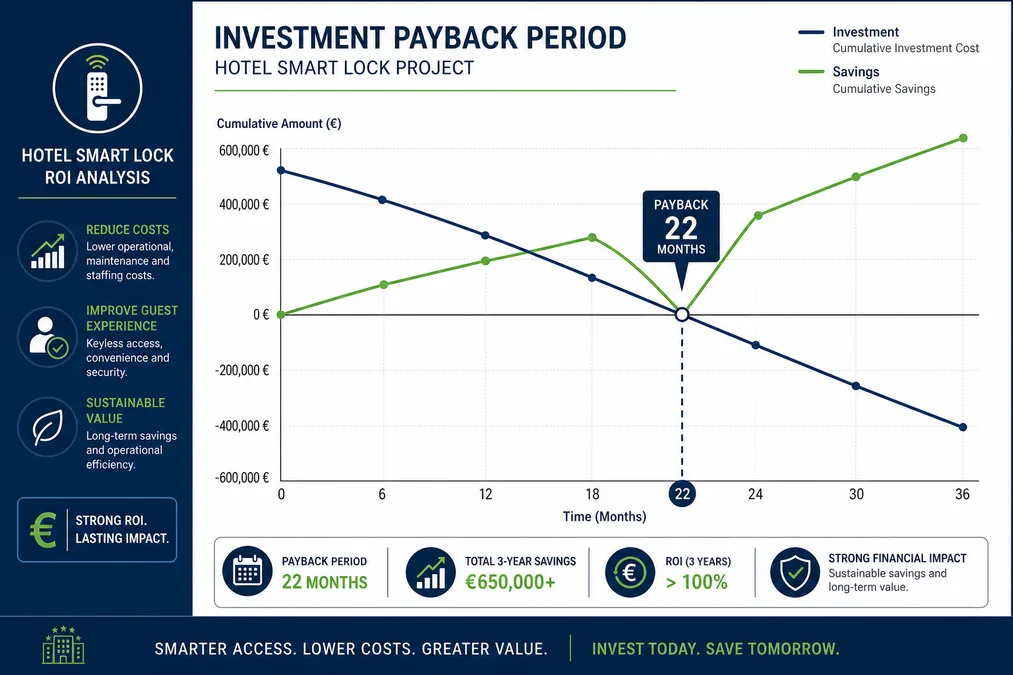
Example Calculation of Simple Payback Period
Required assumptions:
- Room count, selected model, configuration, accessories and quoted unit cost.
- Hardware total based on the approved quotation.
- Deployment and integration total based on the site scope.
- Total investment (CAPEX): calculated from confirmed inputs.
Annual Quantifiable Benefits (Direct savings only):
- Front-desk productivity value: calculated from the hotel baseline.
- Energy or consumable savings: included only where measured or agreed.
- Total annual benefit: calculated from confirmed inputs.
Simple payback period: total confirmed investment divided by confirmed annual benefit. The result is valid only for the stated project assumptions.
Illustrative Hotel Project Scenarios
The following scenarios are planning prompts, not WAFU customer cases or measured results. A hotel team can use them to define a pilot and collect evidence before a wider rollout.
- New-build or major renovation: Confirm door profiles, network design, PMS scope, emergency access and handover responsibilities before finalizing the specification.
- Existing-property retrofit: Sample representative doors and record installation time, guest and staff workflows, battery or power conditions, and failure-handling steps.
- Multi-property rollout: Compare site baselines and document model, firmware, access-policy, spare-parts and support differences before using results from one property elsewhere.
Implementation Roadmap: Strategic Planning and Agile Expansion
We recommend an agile implementation strategy that is phased and low-risk:
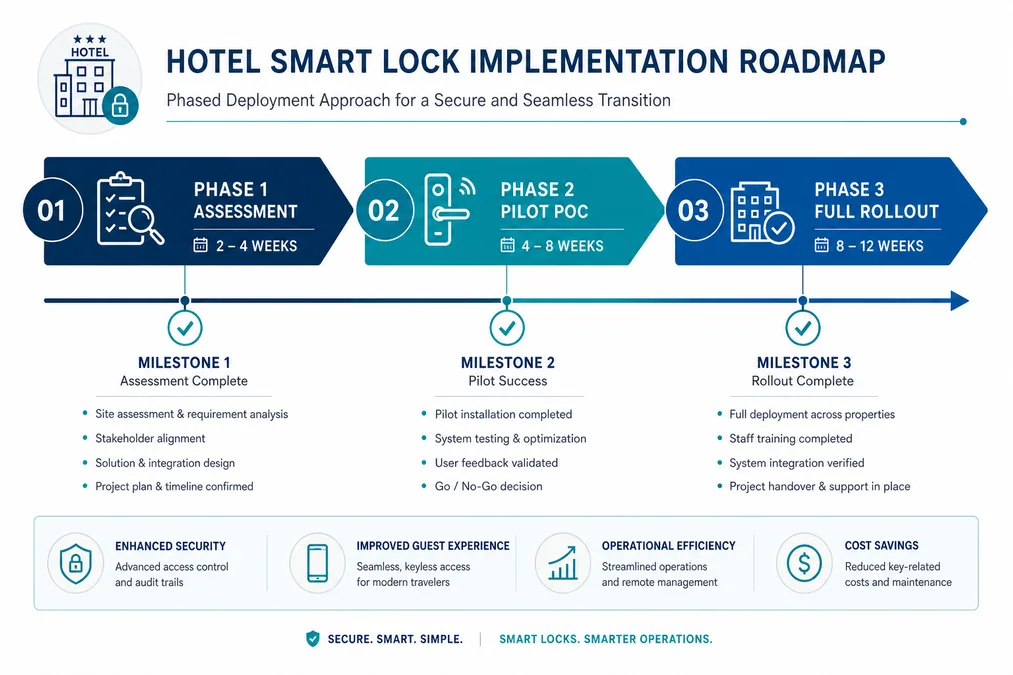
- Strategic Assessment & Planning (2–4 weeks): Define hotel digitalization goals and assess existing IT infrastructure (PMS/network); conduct technical compatibility evaluations and preliminary ROI calculations.
- Proof-of-Concept Pilot (4–8 weeks): Select a typical floor or specific room category (e.g., executive floor) for small-scale deployment to verify system stability, staff workflows, and guest acceptance.
- Technical Integration & Deployment (8–12 weeks, depending on scale): Complete deep API integration with the hotel PMS; execute bulk hardware installation, network configuration, and system commissioning. WAFU provides the WAFU Connect SDK to enable rapid integration of unlocking functions into the hotel's proprietary app.
- Process Re-engineering & Staff Empowerment: Redesign Standard Operating Procedures (SOPs) for front desk, housekeeping, and IT departments based on the new system; conduct targeted training to ensure a smooth transition.
- Guest Guidance & Value Communication: Clearly guide guests in using new features like Mobile Key through multiple channels, including booking confirmation emails, in-hotel digital signage, and proactive front-desk introductions.
- Continuous Optimization & Data-Driven Operations: Utilize cloud platform data to continuously analyze door-opening patterns and energy consumption; optimize access policies and automated scenarios; and explore White-Label solutions to empower hotel group brands with smart access control capabilities.
Certifications & Patents
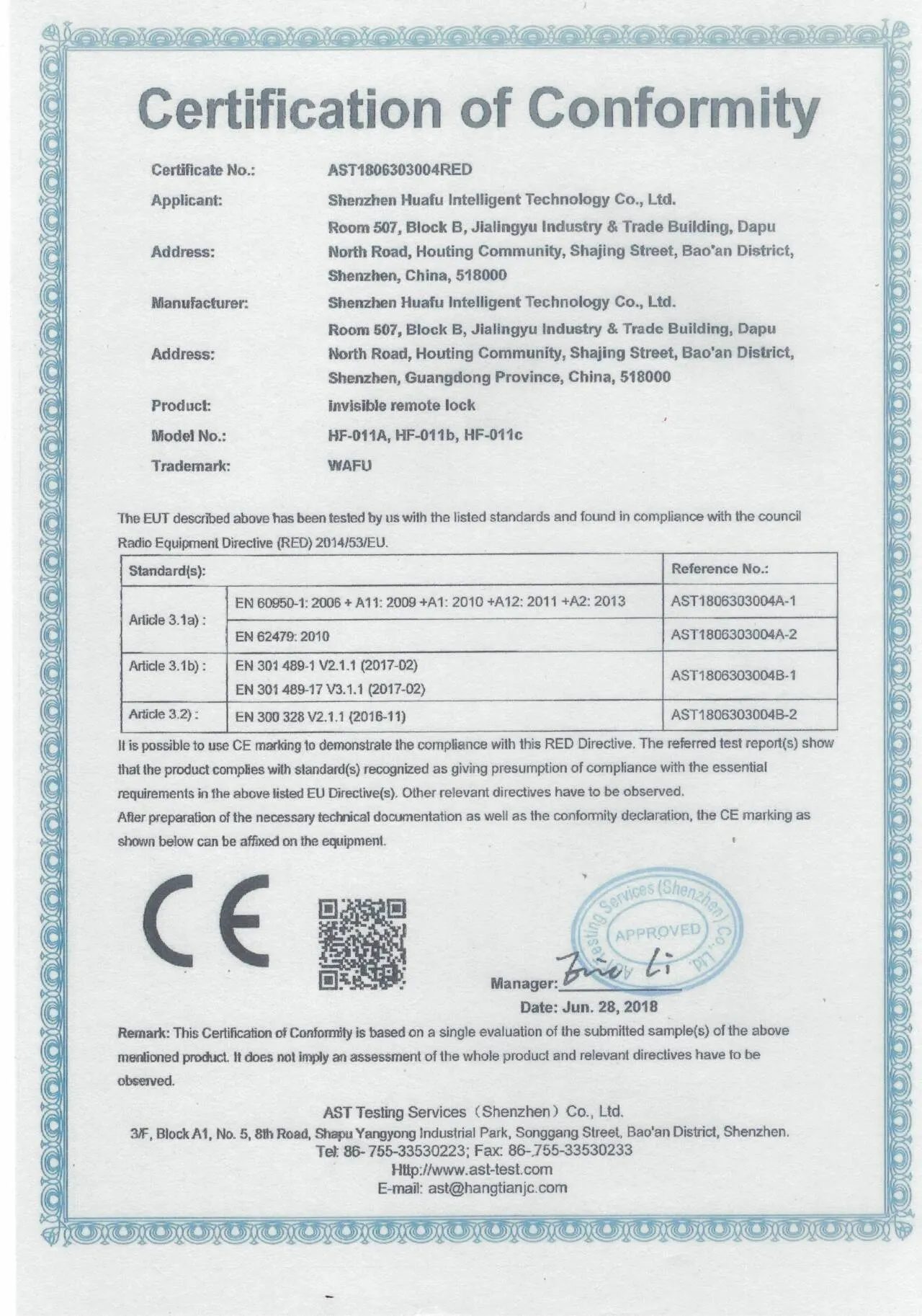
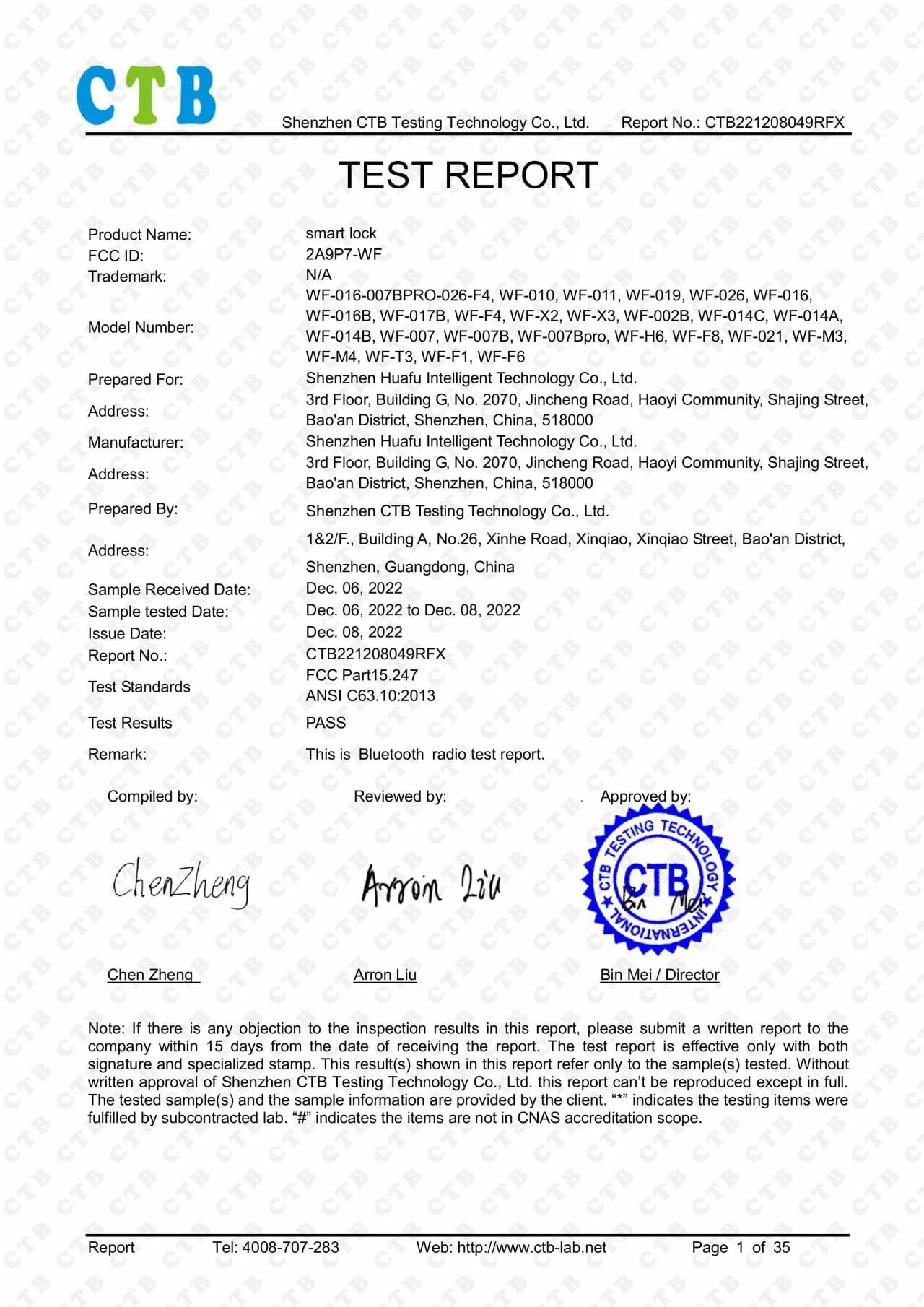
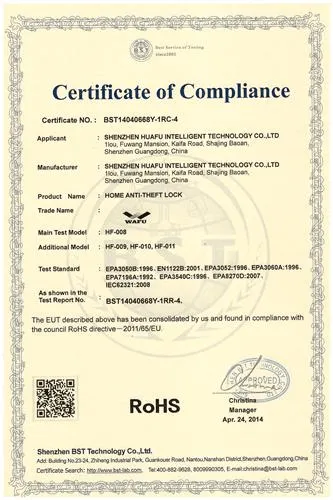
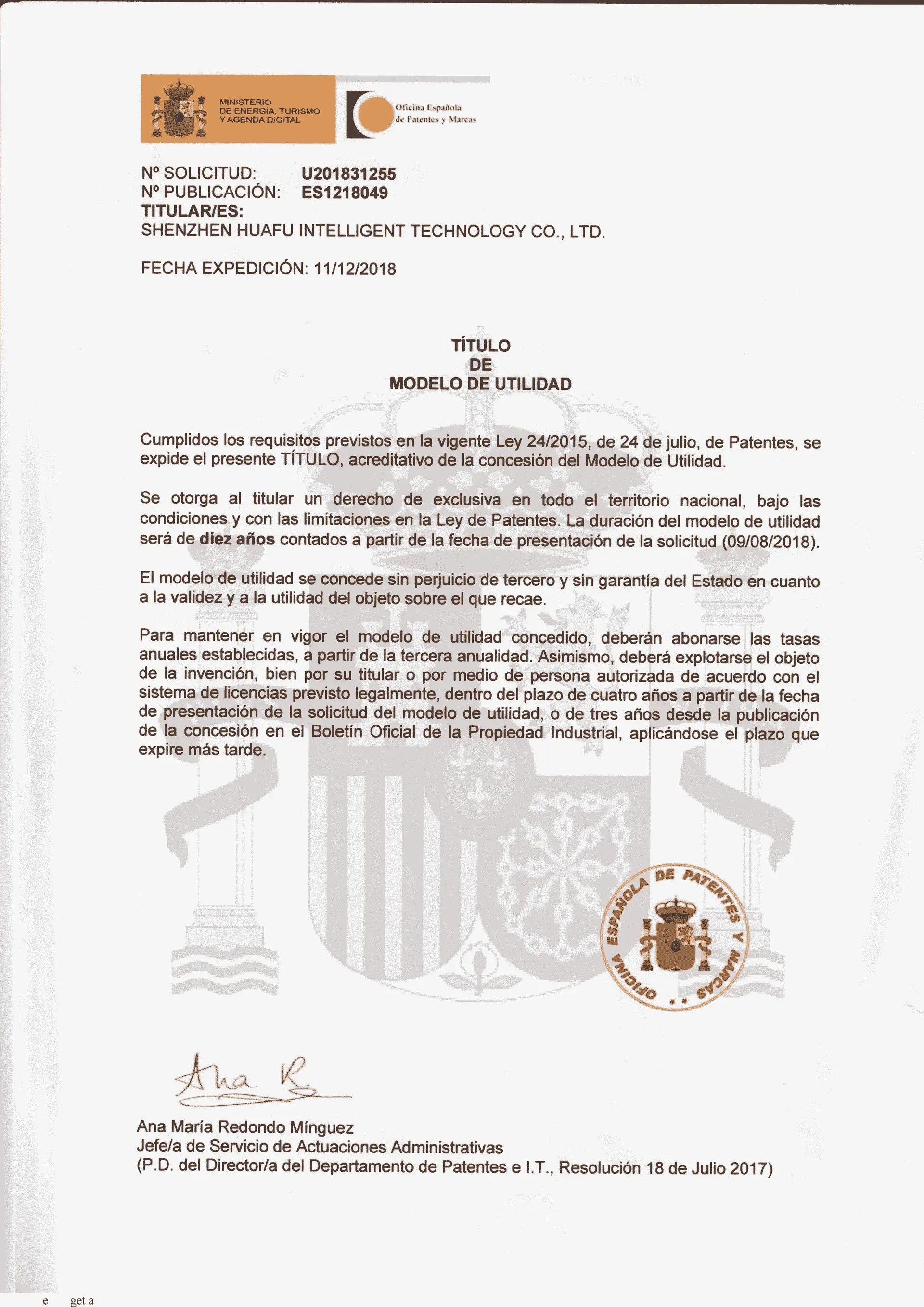
CE Certification · FCC Compliance (Part 15) · RoHS Compliance · Patent Protection (DE/EP/CN, etc.)
Conclusion
WAFU SMART-LOCK+ can be evaluated as part of a broader hotel access-management upgrade. The decision should combine the confirmed lock configuration, security documentation, PMS scope, emergency procedures, operating costs and measured pilot results. A project-specific ROI model can help hotel operators compare options, but it should not be presented as a guaranteed return or a substitute for site validation.
Next Steps: Your Pathway to a Smarter Hotel
To explore how WAFU SMART-LOCK+ can be tailored to your specific operational goals and property scale, we recommend the following actions:
- Request a Personalized ROI Simulation: Contact our hotel solutions team with your property's basic parameters (room count, PMS type, occupancy rate). We will provide a customized financial model detailing your potential investment, savings, and payback period.
- Schedule a Technical Compatibility Assessment: Our engineers can review your existing IT infrastructure to ensure seamless integration and address any potential technical questions prior to commitment.
- Request a demonstration or pilot plan: Review the relevant configuration through a product demonstration and define a representative site pilot before wider deployment.
The transition to smart access control is a strategic investment in your hotel's future competitiveness and operational resilience. The first step towards quantifying its value for your property begins with a conversation with our team. We also recommend the hotel compatibility guide and the B2B OEM/ODM sourcing white paper for a complete project evaluation.
Disclaimer: Any cost, revenue or performance example is illustrative and must be validated against the selected configuration, site conditions and project records. © 2026 WAFU Smart Lock. All rights reserved.